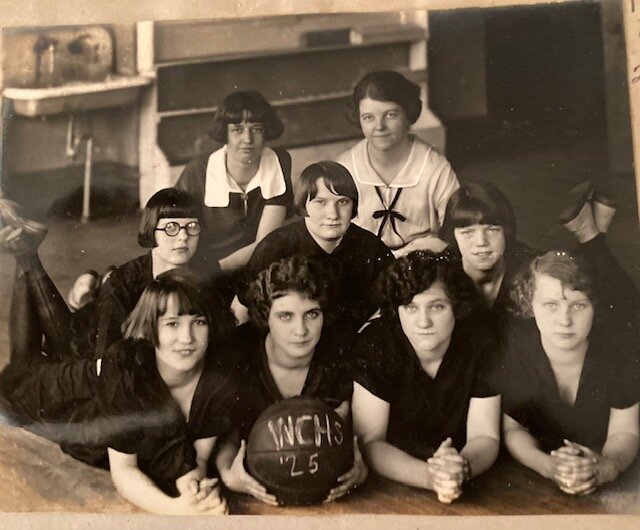
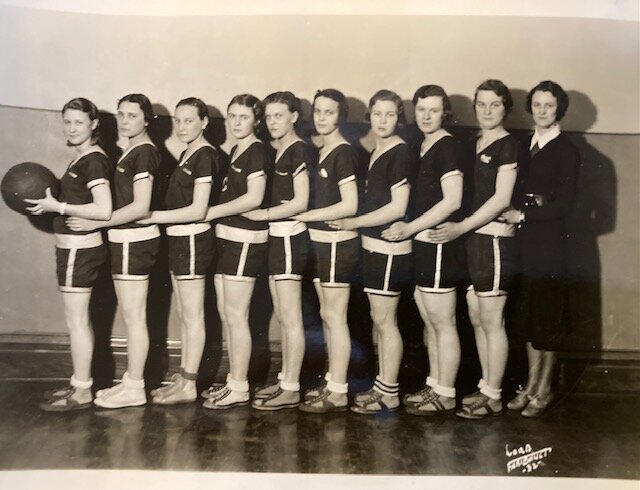
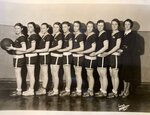
Paging through a new acquisition at the Museum, a fascinating scrapbook of the West Concord High School Class of 1925, a stunning photo of the girls’ basketball team of ’25 looked back at me. Friends had told me about their family members being a part of West Concord’s girls basketball teams in the 20’s and 30’s and yet when my class reached the high school in the late 60’s there were no women’s sport teams. I thought to myself, there must be a story here.
James Naismith invented the game of basketball back in 1891 at Springfield College, MA, where he was a graduate student. The game was brought to Minnesota by his roommate, Max Exner, who had played in the very first basketball game ever.
Max moved to Carleton College in late 1892 to continue his studies and was soon hired as the first “physical culture” instructor at Carleton. During the winter of 1893 he introduced basketball to his women students. Even though they had to play in an unventilated 30’ x 36’ gym that was in the lower level of the women’s dormitory the women were highly enthusiastic about the game. Here’s what the 1892-93 yearbook said about the newly inaugurated basketball program:
“ . . . you should have seen the fun. See the ladies on the floor, attired in loose dresses permitting free action of the body and tennis slippers upon their feet. They are divided into two sides, standing at opposite sides of the gymnasium; their eyes sparkling with excitement, ready to dash at the ball when put into play. Each individual player dashes to obtain the ball, now darts to obstruct an opponent and again to protect the goal; running dodging, squirming, while exercising her vocal organs to the best of her ability.” The writer concludes, “Are girls fit for the drawing room only? Can they participate in active games as boys can? Were you permitted to witness one of these games you would surely conclude that they can.”
Very quickly the game spread to high schools in southeast Minnesota and West Concord was one of them. At the Museum we have photos and information about West Concord girls basketball teams from 1925 - 1932. The 1925 team was comprised of Viola Zeller, Gertrude Bosshard, Elva Stinson, Ethel Fraley, Marian Tracy, Marian Bosshard, and Katharine Wilson. They played wearing black bloomers!
In the 1928 WCHS yearbook girls athletics is covered along side the boys athletics.
The girls played 12 basketball games that year with opponents of Mantorville, Kasson, Hayfield, Kenyon, Randolph, and Dodge Center. The players were Rose Robinson, Edna Jaeger, Lorene and Marion Zeller, Margaret Whiting, Luella Fairbanks, and Carmen Spreiter. The yearbook reported that “the team did not strike their pace until near the end of the season.”
The 1929 WCHS yearbook has a page and a half account of the girls basketball team’s year. Getting to games was not as easy as today. The team made its way to games by various modes of transportation, including everyone piling in a truck, on a sleigh, and on the train. New members of the team in ’29 included Elna Campbell, Marguerite Henry, Mildred Wilson, and Hazel Gochnauer. The scores from the games were lower than those of girls games today: a typical score from 1929 was West Concord 18 — Hayfield 12. The 1929 team won the most games of any team in the county that year. West Concord’s games were played at City Hall which we know as the “Muni” today.
By 1937, on examining the WCHS school year book, there is no girls basketball team or any mention of girls athletics. What happened? In the 1920’s the National Amateur Athletic Federation was created to make recommendations about athletic participation in the U.S. There was thought to be little gender bias in the Federation’s work since most of the leaders were women, including President Hoover’s wife, Lou. The NAAF was concerned that the girls’ model of sports participation was too closely aligned with the boys’ model, and far too competitive. The Federation decided it needed to put girls’ health first and remove them from competitive sports. Both those in the field of physical education and medicine believed that women weren’t built for the rigors of competition and warned that women’s childbearing ability could be damaged by too much strenuous activity. The NAAF reported its findings to state departments of education throughout the country. They in turn contacted local superintendents of schools throughout their states and during the early 30’s girls basketball and other girls sports began to be dropped throughout the U.S. What a travesty!
That brings me back to 1968 when girls’ high school options for anything athletic were cheerleading, pep club and the GIrls Recreation Association (GRA). I was a student during that 40 year gap when there were very few, if any, sports team outlets for girls. What brought us back to the world of vibrant girls sports teams we have today? More than anything, it was the passage of the Federal Title 9 law in 1972 that prohibited sex-based discrimination in any activities that receive federal funding. At last the WCHS 1972 yearbook shows the records of girls basketball, gymnastic, softball, and track and field teams for the first time since the 1930’s. Girls sports teams had returned to stay.
As one of the girls on the 1929 team reported at the end of the season, “We returned our suits to Miss Peters (coach) with regrets, but retained our many fond memories and benefits of basketball for ourselves.” Those girls would have enjoyed wearing a popular t-shirt of today that shouts out, “Yes, I do play like a girl—try to keep up!” If you’d like to see more photos of the WCHS girls teams of the 1920’s and 30’s, be sure to stop by the Museum.